
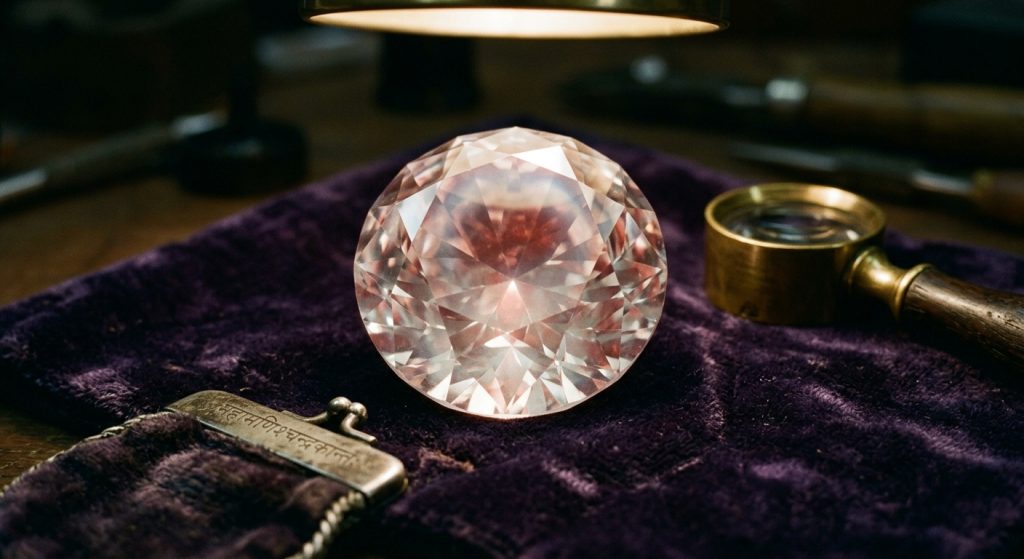
I've just closed the final page of The Moonstone, Wilkie Collins' 1868 novel — 158 years old this year, and still credited by many as the book that gave modern detective fiction its shape. A priceless diamond vanishes from a country house on the night it's given as a birthday gift, and every person under that roof gives a slightly different account of the evening it went missing.
Reading it wasn't just entertainment. It was a working lesson in the thing I've spent years trying to build.
The manners are doing the hiding
The social detail is what stayed with me longest. The way characters present themselves. The rigid courtesies covering real motive. Even the medical remedies of the day — a doctor prescribing champagne for a nervous complaint, as though it were the obvious treatment.
None of it is incidental. It all builds the world the mystery lives in, and it's a reminder that a good mystery is never only about the crime — it's about the society that produced it. Every gesture, every polite evasion, is doing double duty. Half the pleasure is learning to read past the manners to what's actually being withheld.
That principle survives intact into everything we make. A bank statement is not just a bank statement. A witness statement is a person choosing which words to use about themselves.
The puzzle, before you're given anything to hold
The opening stretch of The Moonstone does exactly what a great mystery should: it makes you sit with the who, the how and the why, turning them over long before you're handed anything solid. Collins refuses to let you settle. Several people could plausibly have taken that diamond, and he keeps all of them standing for a very long time.
That's the feeling I've spent years trying to bottle — and it's harder to manufacture than it looks. Writing one guilty person is easy. Writing three people who all look guilty, and keeping them all upright until the last piece lands, is most of the work in every case we ship.
Where the habit started
It goes back further than this book, if I'm honest. Long before Collins, I was working through a series of children's mysteries — three friends chasing down clues together — and something about that habit of noticing, doubting and reasoning never left me. It followed me into adulthood, through every crime novel and detective show since, and it's the same instinct that eventually became Exhibit A Mysteries.
What we build, and why it looks like this
Crime investigation puzzles you can hold in your hands and solve at your own table. Each case starts as a printed evidence pack — statements, reports, photographs, financial records, the physical paper trail — and layers in a set of digital gates: inboxes, banking portals, archives, all locked behind details you have to dig out of the evidence itself.
Nothing is handed over as a conclusion. If a fact can be shown through something you have to go and find, we don't print it as a statement. That rule came straight out of books like this one, where the reader is trusted to do the work.
The Moonstone isn't the only book behind how we build — the shelf includes plenty of other classic and modern crime writing — but it's a good example of the tradition we keep drawing from. Whether you want something to argue over with friends across a weekend, or a case to work through alone on a quiet evening, that tradition sits behind every one we release.
Read it free, before you buy anything of ours
Here's the part I'd rather say plainly than bury: The Moonstone is out of copyright, and you can read the whole thing legally, free, with no account and no email address, on Project Gutenberg.
It's 158 years old and it still holds. If you want to know whether the kind of mystery we make is the kind you enjoy, a weekend with Collins will tell you more honestly than any product page can. We keep a longer list of genuinely free options — and an honest account of what a paid case costs to produce — in our guide to free murder mystery games.
What's next
The Moonstone gave the genre one of its founding puzzles, and we think it deserves a case of its own. We're working on reviving it as an original Exhibit A Mysteries investigation — same DNA, new evidence, built for solving at your own table.
If you'd like to be first to know when it lands, subscribe using the form at the foot of this page, or follow us on Instagram and Facebook.
Until then: if you haven't read The Moonstone, it's well worth the detour. And if you'd rather solve something than read it, our current cases are waiting.